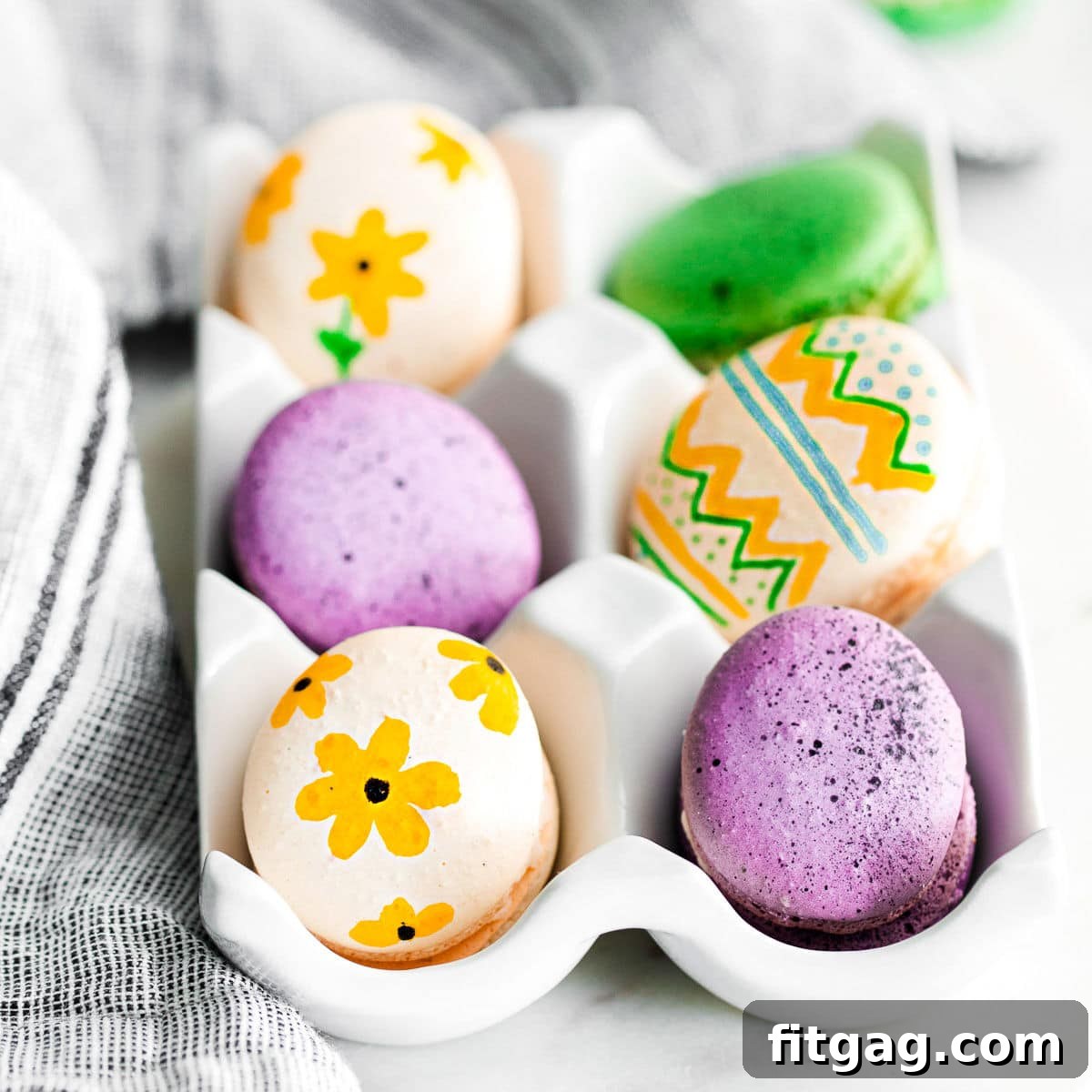
As Easter approaches, the air fills with anticipation for festive celebrations, family gatherings, and, of course, delightful treats. This year, elevate your holiday dessert table with these absolutely enchanting Easter Macarons. Crafted with precision and decorated to mimic beautiful Easter eggs, these delicate French confections are more than just a dessert – they’re edible art, guaranteed to be the star of your holiday spread. If you’re planning your Easter menu, don’t forget to explore other holiday favorites like my Coconut Macaroons and refreshing Cream Cheese Mints.
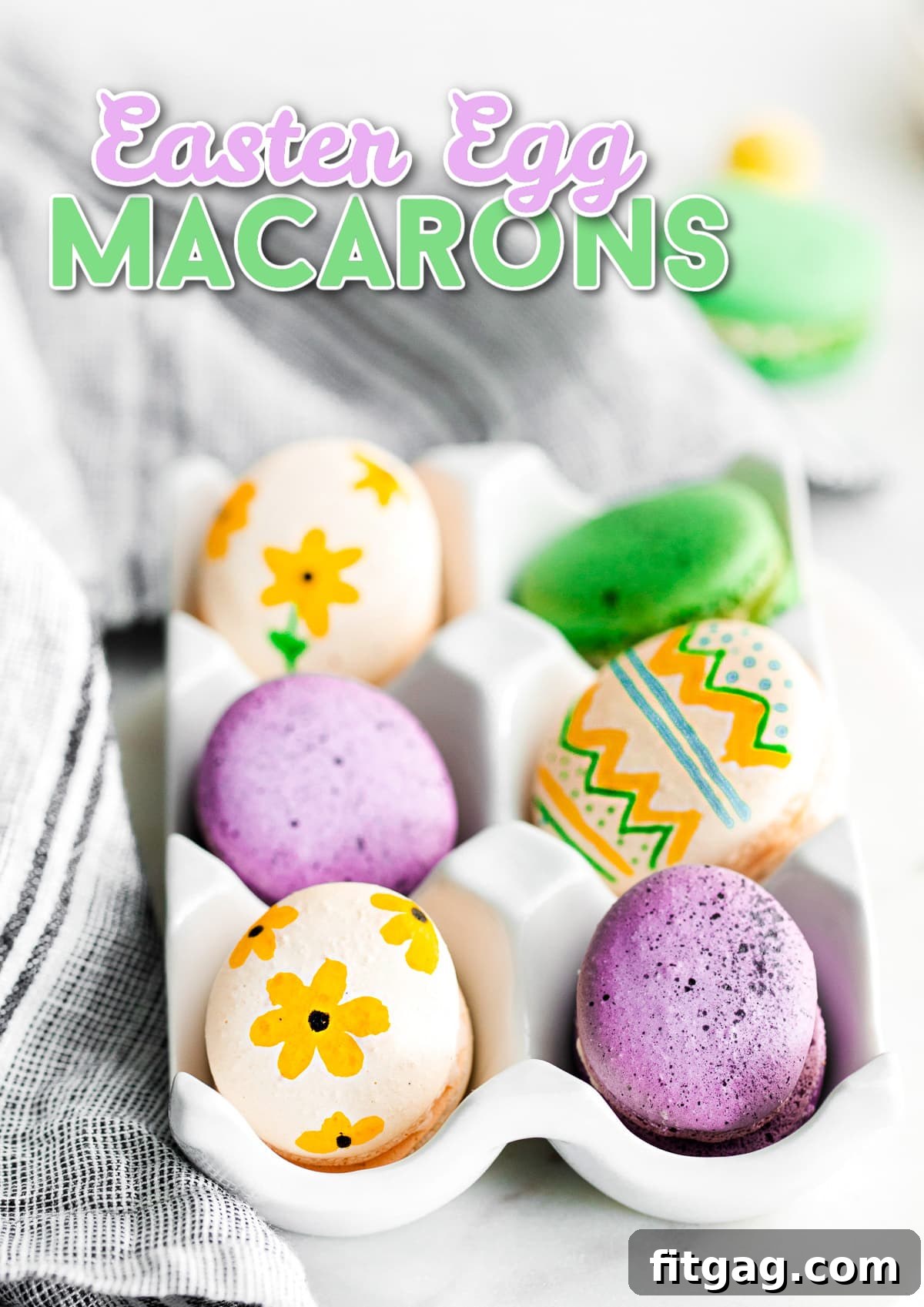
While last month we celebrated with delicious Irish Cream Macarons, perfectly suited for St. Patrick’s Day, today, we’re diving into the joyous spirit of spring with these irresistible Easter Egg Macarons. They are the epitome of festive baking, combining classic French elegance with the playful charm of Easter.
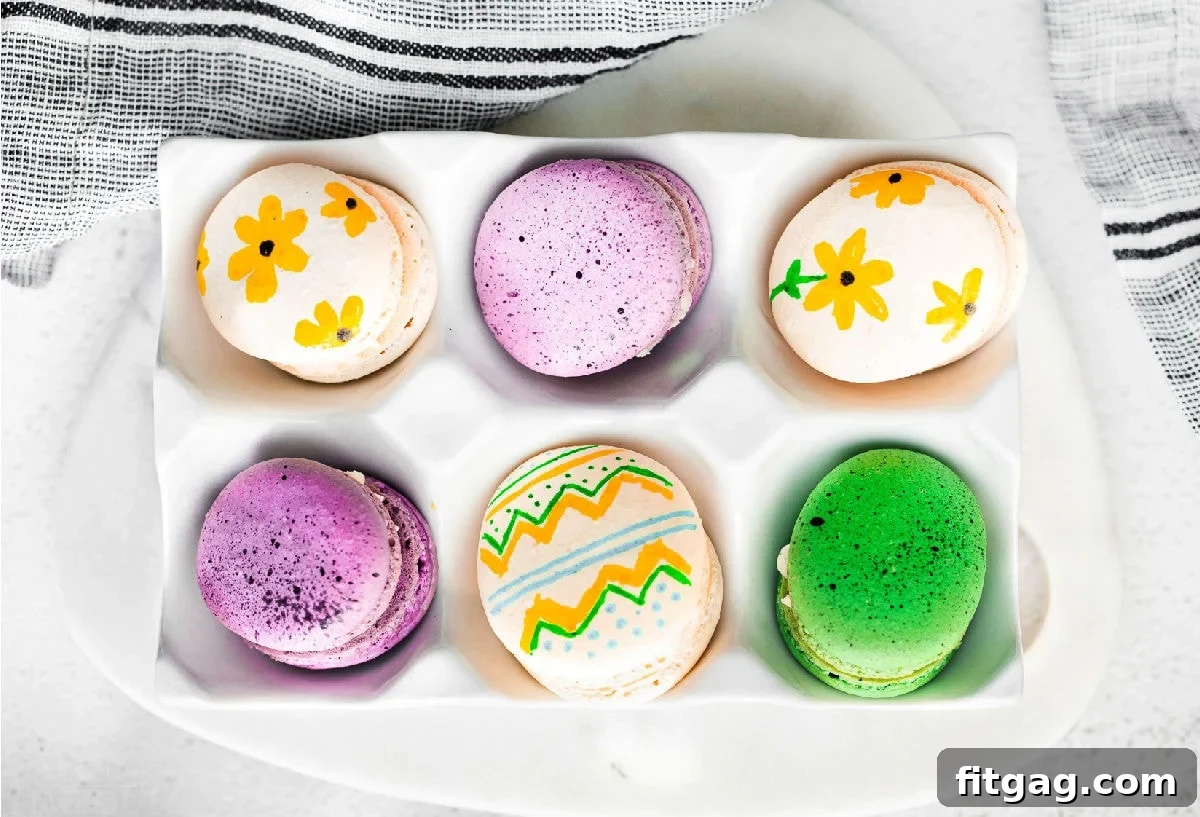
These exquisite macarons are meticulously shaped like miniature eggs and then adorned with vibrant, whimsical decorations, transforming them into a dessert that’s almost too beautiful to eat. Each bite offers a delightful balance of a crisp, delicate shell and a rich, creamy filling, making them an unforgettable addition to any Easter celebration.
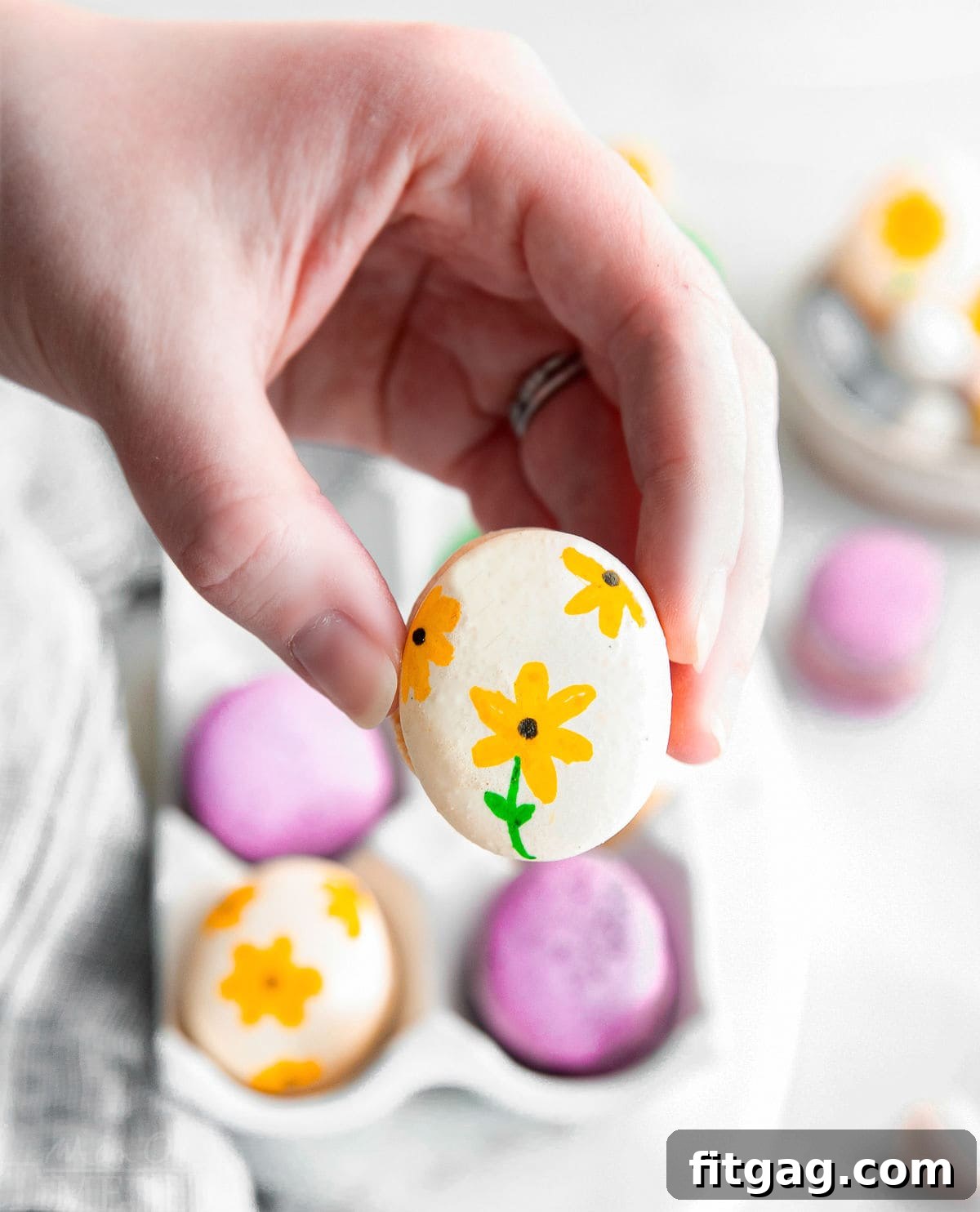
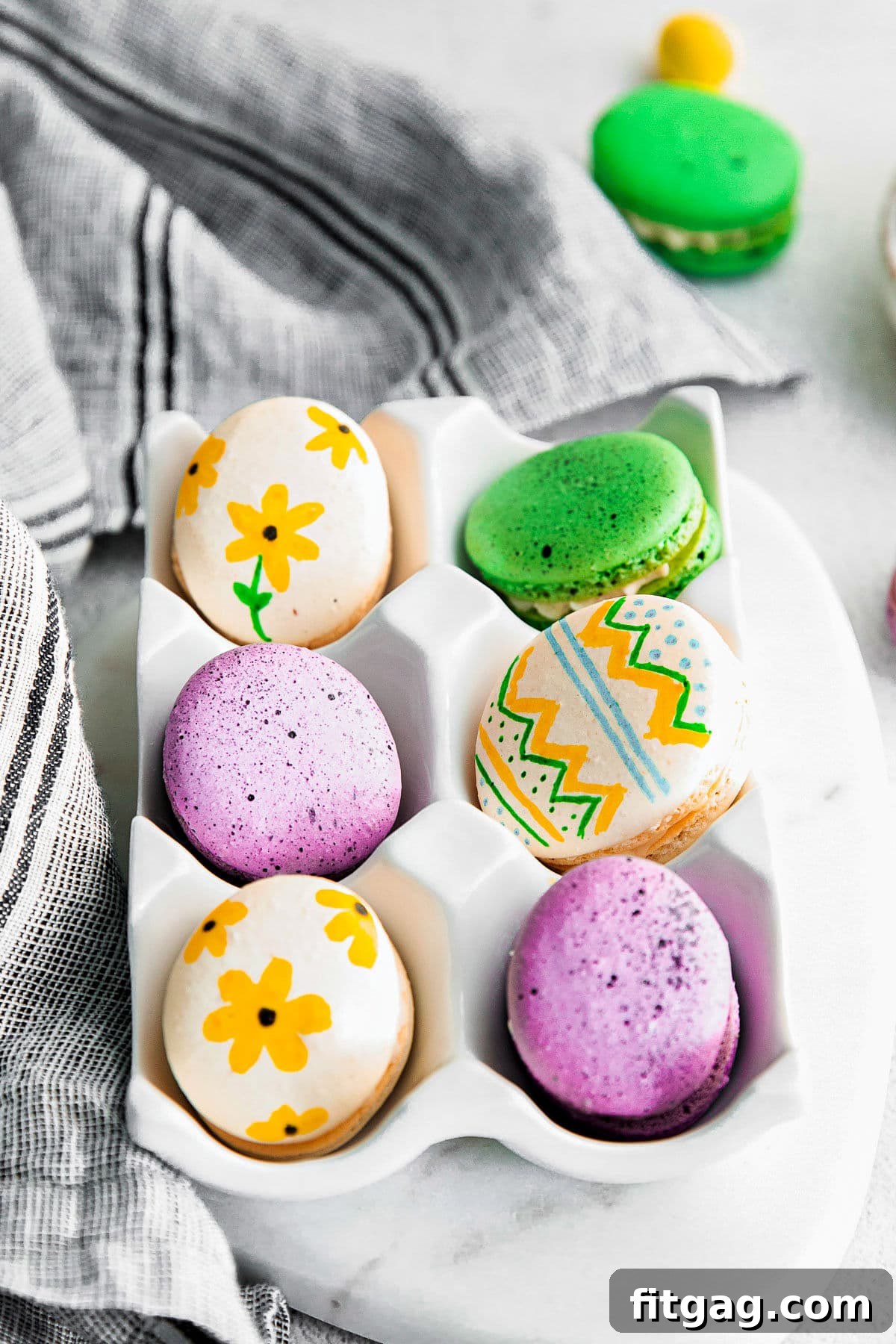
To achieve their stunning Easter egg appearance, I employed two distinct and creative decorating techniques:
- Food Coloring Pens: These ingenious tools are a baker’s best friend for intricate detailing. Readily available at craft stores, major retailers, or online, food coloring pens allow for precise drawing directly onto the smooth macaron shells. They offer an effortless way to create a diverse array of beautifully decorated Easter macarons, from simple stripes and dots to more elaborate designs. A high-quality set of food-grade coloring pens is a fantastic investment for any aspiring macaron artist.
- Speckled Egg Technique: This method, which I also used for my popular Easter Cake, creates a charming, rustic effect. It involves artfully splattering diluted gel food coloring onto the macaron tops using a pastry brush. The key is to achieve a fine mist of color that resembles natural speckles on a bird’s egg. When using this technique, always exercise extreme caution. Food coloring, especially gel varieties, can stain surfaces, clothing, and skin. Ensure you adequately protect your workspace with old newspapers or plastic sheeting to avoid any unwanted messes.
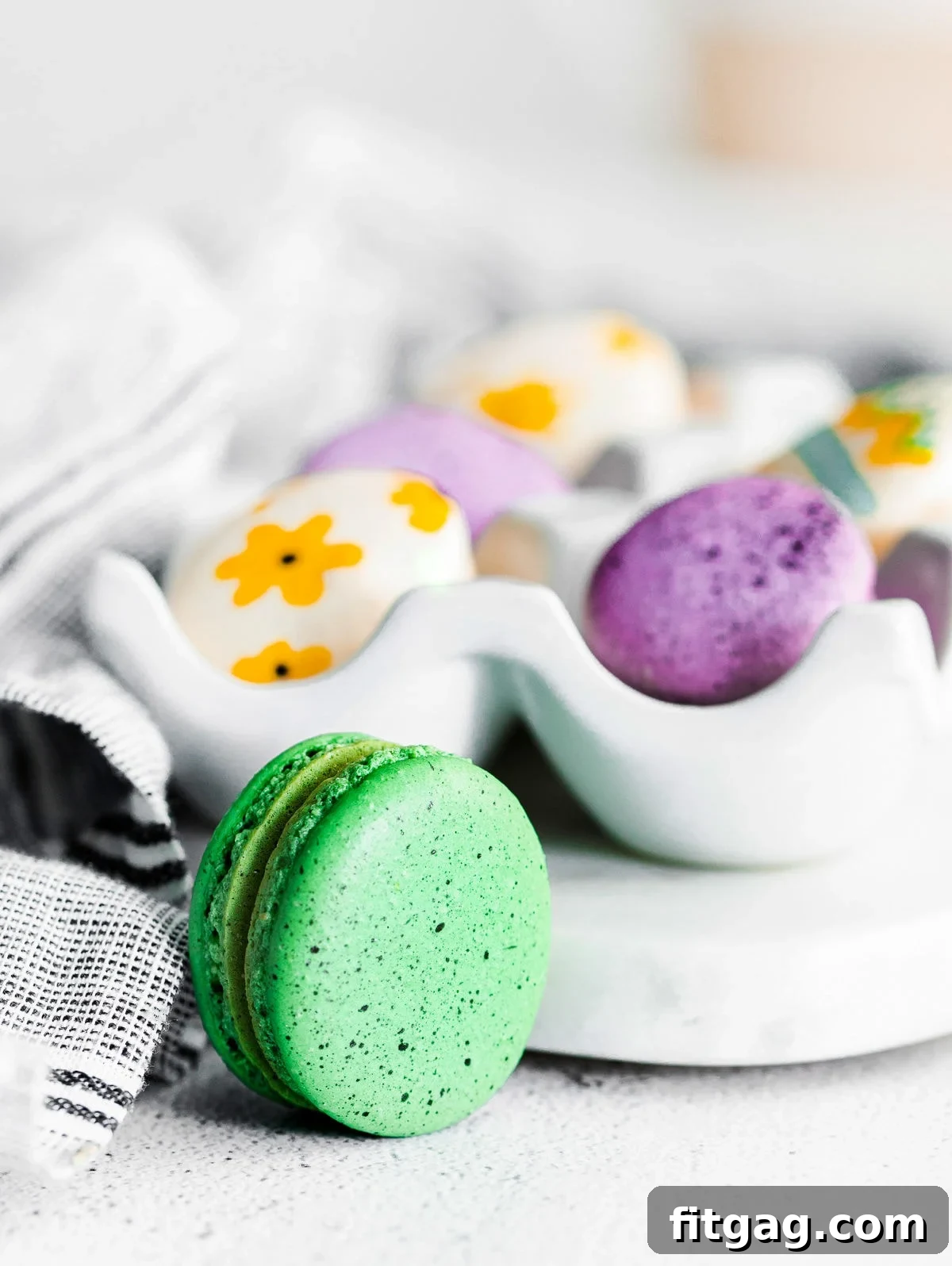
Exquisite Easter Macarons: A Festive Delight
Beyond their undeniable visual appeal, these Easter Egg Macarons offer a truly sensory experience. Their delicate, crunchy shells give way to a soft, chewy interior, perfectly complemented by the rich, creamy filling. While mastering the art of French macarons can seem daunting, requiring a blend of technique and patience, my detailed, easy-to-follow guide will walk you through each step. You’ll be creating a batch of these beautiful, delectable treats in no time, impressing everyone with your newfound macaron-making prowess.
Understanding the French Macaron: A Culinary History
Macarons are iconic French confections, though some culinary historians trace their origins back to Italy. These elegant sandwich cookies have graced dessert tables for centuries, with records indicating their presence since at least the 19th century. Distinguished by their smooth, dome-shaped tops, ruffled “feet” (the characteristic bubbly edge), and delicate texture, macarons are a testament to refined baking.
The delicate shells of these cookies are typically crafted from a precise blend of egg whites, granulated sugar, powdered sugar, and finely ground almond flour. The magic happens when these ingredients are carefully combined and baked, resulting in a slightly crisp exterior and a tender, chewy center. The filling nestled between two macaron shells is where creativity truly shines, with endless flavor possibilities. For our festive Easter Macarons, we’re using a classic and universally loved vanilla buttercream, offering a perfect balance to the almond shells.
Essential Macaron Ingredients: The Foundation of Flavor
Creating these exquisite French Macarons requires a surprisingly short list of ingredients, emphasizing quality over quantity. Each component plays a vital role in achieving the signature texture and taste. You’ll find the complete, printable recipe with exact measurements at the bottom of this post, but let’s take a closer look at what you’ll need to gather:
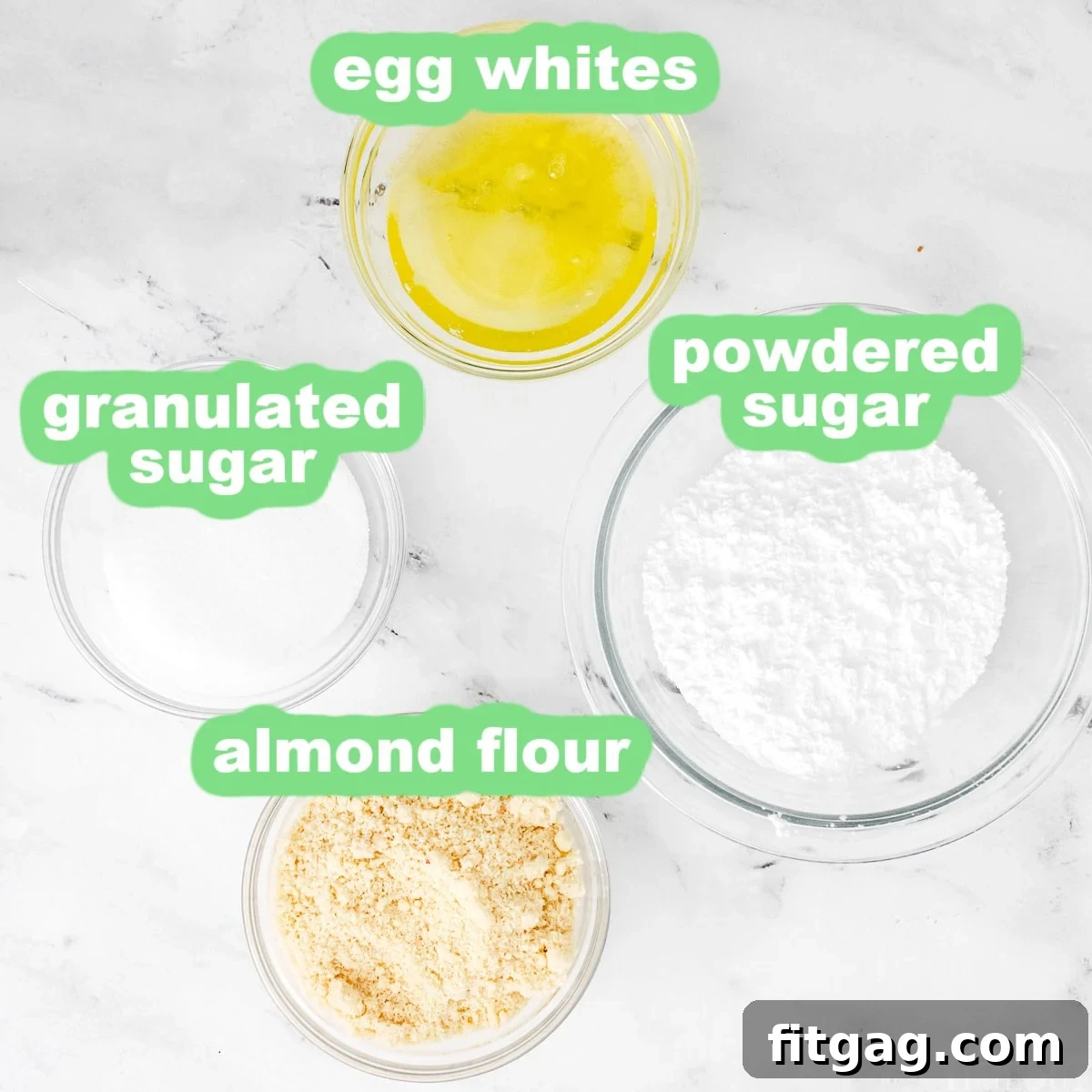
For the Delicate Macaron Shells, You’ll Need:
- Egg Whites: These are unequivocally the most crucial ingredient for macaron shells. The quality and preparation of your egg whites directly impact the final meringue. For best results, I highly recommend separating your egg whites a day or two in advance and letting them come to room temperature before whipping. This ensures they whip up more easily and achieve maximum volume, creating a stable meringue.
- Granulated Sugar: This isn’t just for sweetness; granulated sugar is essential for stabilizing the egg whites and helping them transform into the glossy, stiff meringue that forms the foundation of macaron shells. It helps the egg whites stretch and hold air, providing structure.
- Powdered Sugar (Confectioners’ Sugar): Finely milled powdered sugar contributes to the light, airy, and wonderfully sweet texture of the macaron shells. It also helps create that smooth, delicate surface characteristic of perfect macarons.
- Almond Flour: Blanched and finely ground almond flour is what gives macaron cookies their distinct, slightly chewy texture and nutty flavor. Ensure you use a high-quality, superfine almond flour for the smoothest shells and avoid almond meal, which can be too coarse.
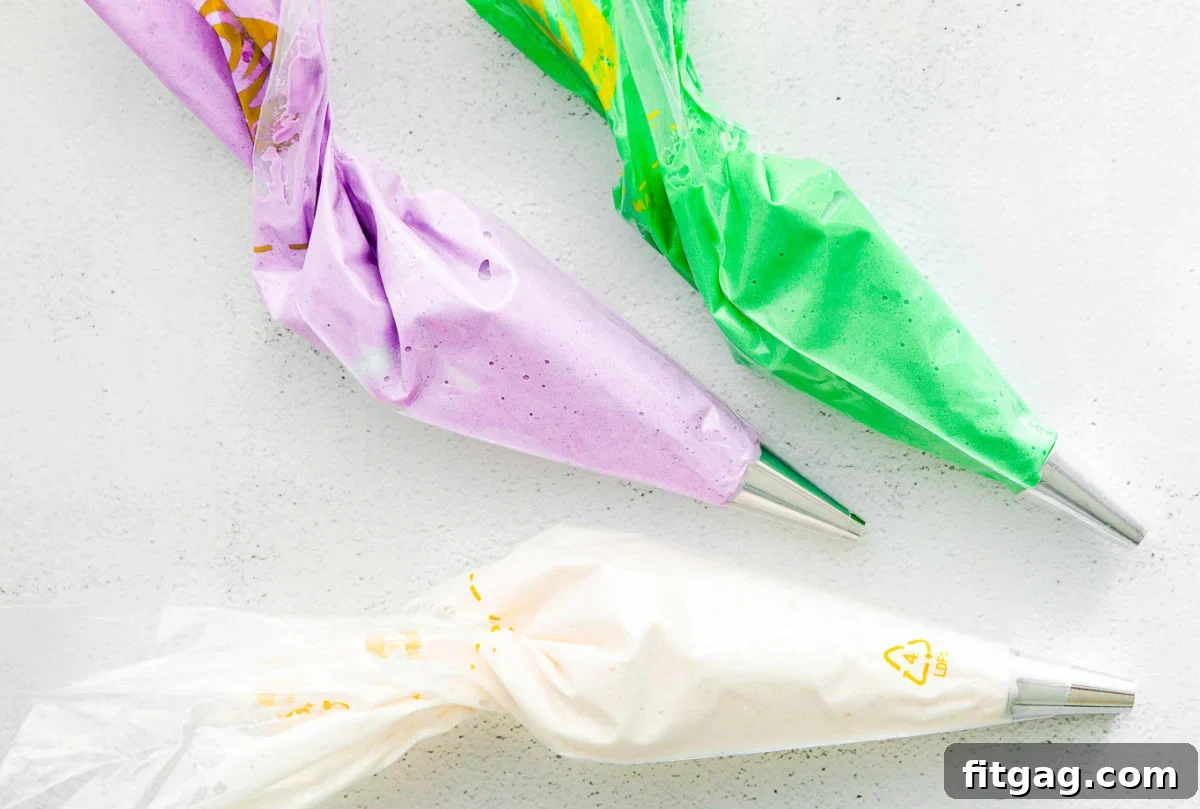
To infuse our Easter Egg macarons with vibrant holiday colors, I suggest dividing the prepared batter into several portions. For a purplish-pink hue, I combined one drop of purple and one drop of pink gel food coloring into one third of the batter. Another third was colored a cheerful green by mixing one drop of royal blue with one drop of yellow. The final third I kept pristine white, allowing for a lovely contrast. Of course, feel free to unleash your creativity and choose any colors you desire – just remember that gel food coloring is essential, as liquid food coloring can introduce too much moisture and compromise your batter’s consistency.
For the Velvety Buttercream Filling:
- Butter: The foundation of any good buttercream, softened butter provides richness and a smooth base for our delicious filling.
- Powdered Sugar: Essential for achieving the light, delicate sweetness and smooth texture of buttercream, ensuring it’s never grainy.
- Vanilla Extract: A classic flavor enhancer, vanilla extract adds a warm, aromatic depth to the buttercream, making it irresistibly delicious.
- Heavy Cream or Milk: Used sparingly, a tablespoon or two of heavy cream or milk can help thin the buttercream to the perfect piping consistency, if needed.
Crafting the Perfect French Macarons: A Step-by-Step Guide
Whether this is your inaugural attempt or your tenth time tackling macarons, the process can often feel a bit intimidating. But fear not! With careful attention to detail and by following these simple, sequential steps, you will undoubtedly achieve a batch of stunningly delicious and picture-perfect French Macarons. Patience and precision are your best friends here.
Phase One: Preparing the Macaron Batter (The Shells)
- Begin by lining two half-sheet baking sheets with either silicone baking mats or parchment paper. If using parchment, ensure it lies perfectly flat to prevent lopsided macarons; you can temporarily secure the corners with a tiny dab of batter if needed, removing it before baking.
- Fill a small saucepan approximately halfway with water and place it over medium heat. Position a heatproof bowl (such as a stainless steel mixing bowl) over the saucepan, ensuring the bottom of the bowl does not touch the simmering water. This creates a double boiler effect.
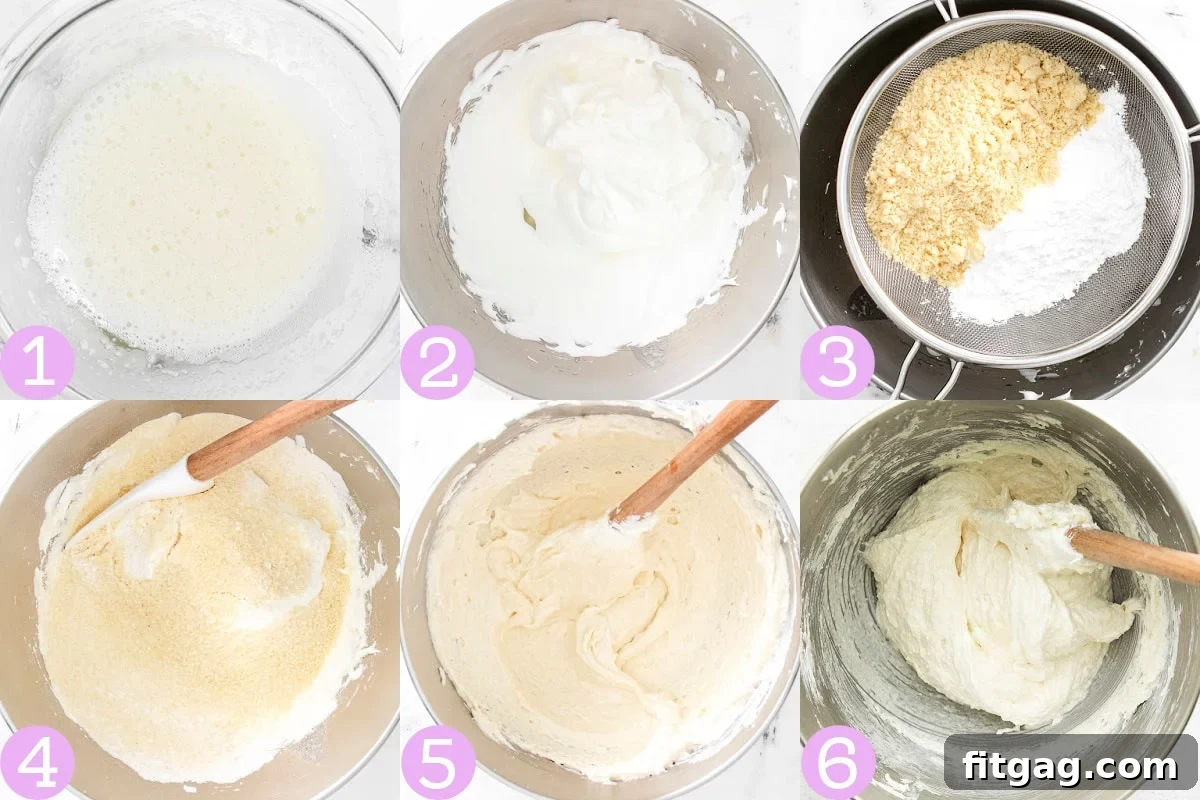
- Add the measured egg whites and granulated sugar to the bowl over the double boiler. Whisk the mixture constantly for about 2 to 3 minutes, or until the sugar has completely dissolved. To test, rub a small amount of the mixture between your fingers; it should feel perfectly smooth, not grainy.
- Carefully transfer the warmed egg white mixture to a clean, dry bowl of a stand mixer fitted with the whisk attachment. Beat on medium-high speed until the mixture transforms into a firm, glossy meringue with stiff peaks. This typically takes around 5 minutes. Stiff peaks mean that when you lift the whisk, the meringue holds its shape without collapsing.
- Into the prepared meringue, sift the powdered sugar and finely ground almond flour. Sifting is crucial to eliminate any lumps, ensuring a smooth macaron shell.
- Using a flexible spatula, gently begin folding the dry ingredients into the meringue. Use a “cut and fold” motion, drawing the spatula down the middle and then sweeping it up the side of the bowl, rotating as you go. Be careful not to deflate the egg whites at this stage; the goal is just to incorporate the dry ingredients without losing too much air.
- Once the dry ingredients are just incorporated, add your gel food coloring, if you are coloring your macarons (refer to the recipe notes for coloring suggestions). Continue the folding process, but this time, gently “smush” or press the batter against the sides of the bowl in a circular motion, then scrape it down and fold it back together. This “macaronage” process is critical for achieving the correct batter consistency.
- Repeat this deflating and folding process, continuing to gently work the batter until it flows smoothly and slowly off your spatula, creating a continuous ribbon-like stream. This is known as the “lava” consistency.
A perfect way to test the macaron batter’s consistency is the “figure 8” test. Lift your spatula, allowing the batter to flow off it. If you can slowly draw a continuous figure eight with the flowing batter before it breaks, it’s ready for piping! If the stream breaks prematurely or falls in clumps, continue to gently smush and fold the batter a few more times until the desired smooth, ribbon-like consistency is achieved. Over-mixing can lead to flat macarons, while under-mixing can result in lumpy, cracked shells.
Phase Two: Piping and Baking Your Macaron Shells
- Ensure your large baking sheets are lined with either silicone baking mats or parchment paper, as prepared in the first step.
- Transfer the perfectly prepared macaron batter into a piping bag fitted with an open round tip. A #12 piping tip or a #10 tip is ideal for forming the shells.
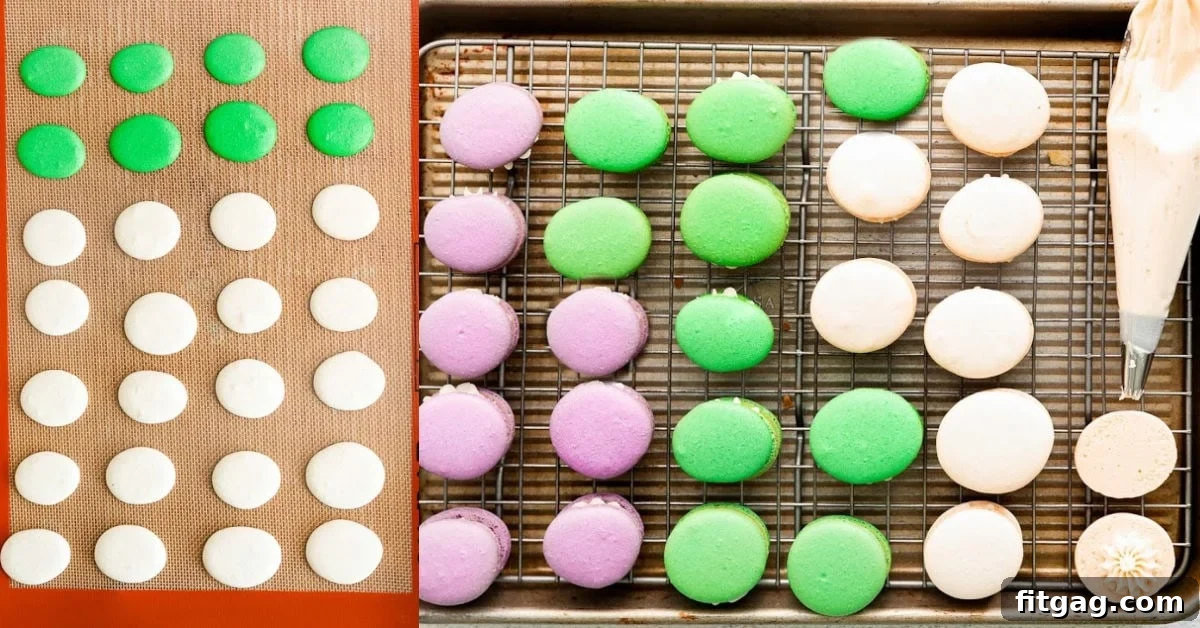
- Pipe uniform 1-inch circles or delicate egg shapes onto the prepared baking sheets, spacing them approximately 2 inches apart. Crucially, hold the piping bag perpendicular (straight up and down) to the surface. Using a silicone macaron mat with pre-marked circles can greatly assist in achieving consistent sizing and shape.
- Once you’ve finished piping one tray, firmly tap the baking sheet on your counter or drop it straight down onto the counter five or six times from a height of about 4-6 inches. This vigorous tapping helps release any trapped air bubbles within the macaron batter, preventing cracks during baking and encouraging the formation of those desirable “feet.” Repeat this for the second tray. You’ll notice the piped shells flatten slightly and any small peaks settle.
- Allow the piped macaron shells to “rest” at room temperature for approximately 30 to 60 minutes, or until the tops feel completely dry to the touch and form a slight “skin.” This resting period is crucial for developing the characteristic “feet” (the ruffled edge at the base of the macaron) and preventing cracked shells. The exact resting time can vary depending on your kitchen’s humidity.
- While the shells are resting, preheat your oven to precisely 325°F (160°C). Using an oven thermometer is highly recommended, as oven temperatures can vary significantly, and consistent heat is vital for macaron success.
- Bake the macaron shells one baking sheet at a time for 12 to 15 minutes. If your oven has hot spots, rotate the baking sheet halfway through the baking process to ensure even cooking. The macarons are done when their “feet” have fully developed and they don’t move or jiggle when gently nudged on the baking sheet.
- Once baked, remove the baking sheets from the oven and allow the macarons to cool completely on the mats before attempting to remove them. Rushing this step can cause the shells to stick or break.
Phase Three: Crafting the Creamy Buttercream Filling
- In the bowl of a stand mixer fitted with the paddle attachment, beat the softened butter on medium speed for about 2 minutes, or until it becomes light in color and fluffy.
- Reduce the mixer speed to low and gradually add the powdered sugar, a cup at a time, until fully incorporated. Once all the sugar is added, mix in the vanilla extract until just combined. If the buttercream appears too thick, beat in one tablespoon of heavy cream or milk at a time until it reaches a smooth, spreadable, and pipeable consistency.
- Transfer the prepared vanilla buttercream filling to a piping bag fitted with a piping tip of your choice (a round tip or a star tip works well for macaron filling) and set it aside.
Phase Four: Assembling and Aging Your Easter Macarons
- Once the macaron shells are completely cool, gently peel them from the baking mats. Take a moment to match them into similar-sized pairs, ensuring a uniform and aesthetically pleasing finished cookie.
- Pipe a small dollop of the vanilla buttercream filling onto the flat side of one macaron shell. Carefully place a second macaron shell on top, gently pressing down just until the filling reaches the edges of the shells.
- Now for the fun part: decorating! Use your food coloring pens to draw intricate patterns, stripes, or dots directly onto the macaron shells, transforming them into festive Easter eggs. Alternatively, you can drizzle melted white chocolate for elegant designs. For the whimsical speckled egg effect, combine 1 teaspoon of water with a few drops of black gel food coloring in a small bowl. Using a pastry brush, gently flick the diluted dye onto the assembled macarons, creating delicate speckles. Remember, protect your surfaces and clothing carefully when doing the splatter technique, as food coloring stains.
- Once decorated, arrange the assembled macarons in a single layer in an airtight container. Place them in the refrigerator to “age” overnight. This crucial aging step allows the filling’s moisture to soften the macaron shells slightly, creating that perfectly crisp, yet chewy and melt-in-your-mouth texture that macarons are renowned for.
- Before serving, remove the aged Easter Macarons from the refrigerator and allow them to come to room temperature for about 15-30 minutes. This enhances their flavor and optimizes their delicate texture.
Frequently Asked Questions About Easter Macarons
Here are some common questions about making and enjoying these delightful Easter Macarons:
How should I store homemade macarons?
To maintain their optimal texture and flavor, store your homemade French macarons in an airtight container in the refrigerator for up to 4 days. Allowing them to come to room temperature for a short while before serving will enhance their delicate qualities.
What causes macarons to be lopsided?
Lopsided macarons are a common challenge for bakers. The most effective way to achieve perfectly round and even shells is to hold your piping bag strictly perpendicular to the baking surface when piping. If the piping bag is held at an angle, the batter will spread unevenly, resulting in lopsided shells. While still delicious, they might not have that coveted picture-perfect appearance.
Why is it recommended to “age” macarons overnight?
The “aging” or “maturing” step, where filled macarons are refrigerated overnight, is indeed optional but highly recommended by macaron connoisseurs. This period allows the moisture from the filling to subtly permeate the crisp macaron shells, softening them just enough to create that iconic, delicate chewiness and a more cohesive flavor profile. It transforms them from simply good to truly exceptional.
Trish’s Top Tips for Perfect Macaron Success
Achieving perfect macarons consistently involves a few key techniques. Here are my tried-and-true tips to guide you:
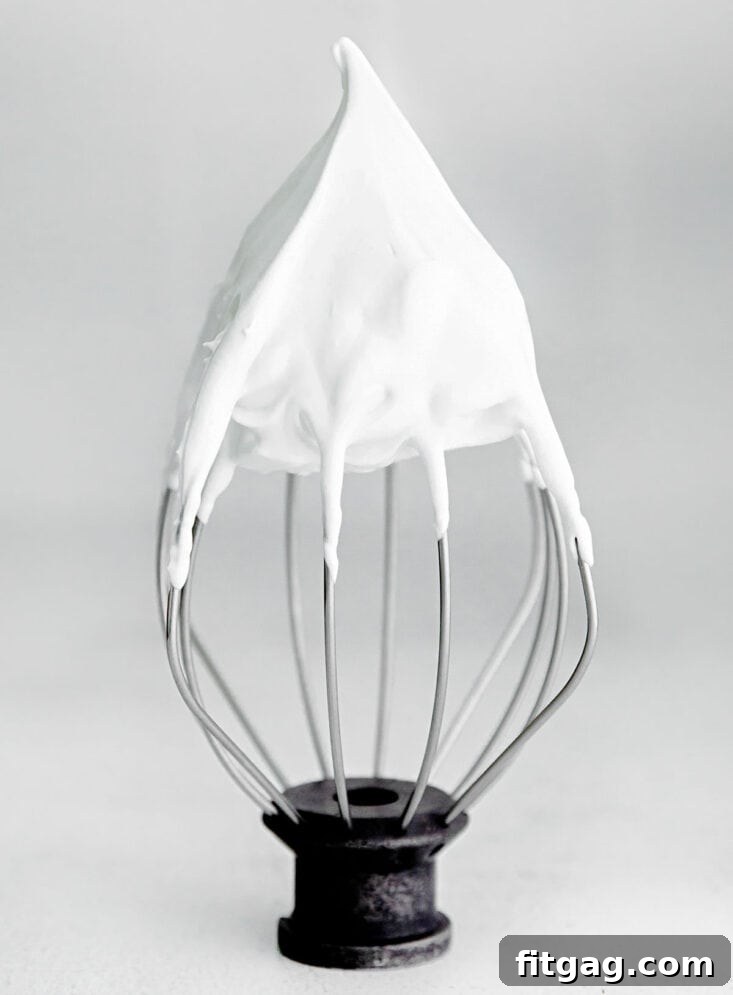
Beat your egg whites until they form truly stiff peaks. This is arguably the most critical step in macaron making. Stiff peaks mean that when you lift the whisk attachment, the meringue stands tall and firm without drooping or folding over. This stable meringue forms the robust structure needed for perfect macaron shells and their signature “feet.”
Invest in quality silicone baking mats. Silicone baking mats are incredibly beneficial for macaron bakers of all skill levels. For beginners, silicone macaron mats often come with pre-printed circles, which serve as excellent guides for piping consistently sized macarons. For advanced bakers, while some prefer the ultra-slick surface of parchment paper, placing a silicone mat underneath a sheet of parchment can still be helpful, as you can see the circle outlines through the parchment, ensuring precise placement and uniform size.
Allow macarons to sit out for a short while before enjoying. The overall texture and depth of flavor in macarons significantly improve when they are allowed to come to room temperature after being removed from the refrigerator. Let them sit for about an hour before serving for the best experience.
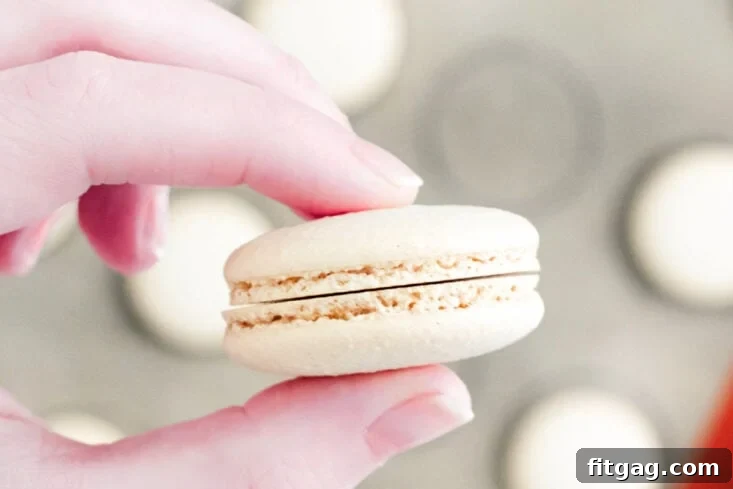
Match up macaron shell sizes before assembly. Once your shells have cooled, take a few minutes to carefully match them into pairs of similar size and shape. This simple step contributes significantly to a more professional and polished appearance for your finished macarons, and it also helps prevent any unsightly oozing of the filling from uneven edges.
Creative Variations to Try for Your Easter Macarons
These Easter Macarons are wonderfully versatile! Here are a few ideas to spark your creativity and customize your batch:
- Add extra flair by drizzling melted white or dark chocolate over your decorated macarons. A sprinkle of edible glitter or colorful nonpareils before the chocolate sets can add a magical touch.
- Experiment with different flavored buttercream fillings. Instead of vanilla, try almond extract for an intensified almond flavor, lemon extract for a zesty twist, or even a touch of raspberry jam mixed into the buttercream for a fruity burst.
- Don’t limit the color to just the shells! You can also tint your buttercream filling with gel food coloring to create a beautiful contrast or a monochromatic look, making your macarons even more eye-catching.
More Irresistible Easter Recipes
Complete your holiday feast with these other delightful Easter-themed recipes:
- Three Minute Easter Fluff
- Easter Cookies
- To Die For Carrot Cake
- Coconut Cream Pie
- Watergate Salad
- Speckled Egg Easter Cake
Easter Egg French Macarons Recipe
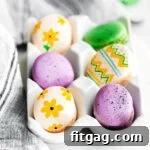
These Easter Macarons are so fun for Easter! Shaped and decorated like Easter Eggs, these French macarons are sure to be the hit of your holiday! A wonderfully festive Easter dessert!
Course: Dessert | Cuisine: French | Keyword: Easter macarons, macaron, macaron recipe
Prep Time: 20 minutes | Cook Time: 12 minutes | Servings: 24 macarons
Calories: 132 kcal | Author: Trish – Mom On Timeout
Ingredients
For the Shell
- 90 grams egg whites
- 90 grams granulated sugar
- 95 grams powdered sugar
- 95 grams almond flour (finely ground)
For the Filling
- 8 tablespoons salted butter (softened)
- 2 ¼ cups powdered sugar
- 1 teaspoon vanilla extract
Instructions
Prepare the Shells
- Line two half sheet baking sheets with silicone baking mats or parchment paper. (If you wish to use parchment, make sure the parchment lays perfectly flat so you don’t end up with lopsided macarons. You can tape the parchment temporarily to help keep it secure while piping and then remove the tape before baking.)
- Fill a small saucepan halfway with water and set it over medium heat. Then, place a heatproof bowl over the pan, making sure it doesn’t touch the water.
- Add the egg whites and granulated sugar to the bowl and whisk constantly until the sugar has completely dissolved. This will take about 2 to 3 minutes. (Test to make sure the sugar is dissolved by rubbing the mixture between your fingers. If it’s smooth, it’s ready to go. If the mixture feels grainy or sandy, keep whisking for another minute or so and then try again.)
- Transfer the egg white mixture to a clean, dry bowl of a stand mixer fitted with the whisk attachment. Beat on medium high until the mixture forms stiff peaks, about 5 minutes.
- Sift the powdered sugar and almond flour into the egg whites.
- Gently fold the mixture together, making sure to scrape down the sides of the bowl as you fold. Take your time and be careful that you are not deflating the egg whites just yet.
- Gently fold the dry ingredients into the egg whites, making sure not to deflate the egg whites. Make sure to scrape the sides of the bowl as you fold.
- Once all of the dry ingredients have been incorporated into the egg whites, add the gel food coloring, if using. (see notes below) Continue folding the meringue but this time begin gently smushing the batter against the sides of the bowl in a circular motion, then scrape down the sides of the bowl and fold it all back together. Repeat this deflating process until the batter flows smoothly off the spatula. (On average this takes about 5 smush and folds but will be dependent on how much you deflate the egg whites each time.)
- You can test the batter’s consistency by slowly drawing a figure 8 with the batter. If you can make an “8” with the batter flowing off the spatula in a constant stream, it’s ready! If it breaks or falls in clumps, smush and fold a few more times until the desired consistency is achieved.
- When the meringue flows smoothly, transfer the mixture to a piping bag fitted with an open round tip. A #12 piping tip or #10 tip works perfectly.
- Pipe 1” circles or egg shapes about 2” apart holding the piping bag perpendicular to the surface. Using a silicon macaron mat will help with this step. Once you’ve finished piping one tray, tap the tray firmly on the counter or drop straight down onto the counter five or six times to release any air bubbles. Repeat for the second tray. The shells will flatten slightly.
- Let the shells rest for about 30 minutes or until the tops feel dry to the touch (this is called developing a skin). This can take up to an hour.
- While the shells rest, preheat your oven to 325°F (you can check the oven temperature using an oven thermometer – this is especially helpful if you think your oven runs a little hot).
- Bake the shells one baking sheet at a time for 12 to 15 minutes, rotating the baking sheet halfway through if necessary. The shells are done when they don’t move or jiggle about when the baking sheets are moved. Allow the macarons to cool before removing them from the tray.
Prepare the Vanilla Buttercream Filling
- In the bowl of a stand mixer, beat butter until it has lightened in color, about 2 minutes.
- Reduce the speed to low and slowly add the powdered sugar. Add the vanilla extract and mix until combined. If the buttercream seems too thick, beat in a tablespoon of heavy cream or milk.
- Transfer the mixture to a piping bag fitting with a piping tip of your choosing and set aside.
Assemble and Age
- Place the macarons in similar sized pairs. Pipe a small dollop of filling on one macaron and place another on top. Press gently, just until the filling reaches the edges.
- To decorate the macarons, use food markers or white chocolate to draw on the macarons. To make the speckled egg macarons, combine 1 teaspoon of water with a few drops of black gel food coloring and use a pastry brush to splatter the food dye on the macarons. Be very careful not to get the food color on any surfaces, clothes, etc. It stains! Make sure to protect all surfaces!
- Place the macarons in an airtight container in the refrigerator to age overnight. Bring to room temperature before serving. Store in the fridge for up to four days.
Notes
- Hold piping bag perpendicular to the baking sheet while piping. Holding it at an angle can result in lopsided macarons.
- Aging the macarons overnight is optional but helps to soften the shell and create that perfect crisp and chewy macaron texture that macarons are known for.
- To color the Easter Egg macarons, I divided the batter into thirds. One third I colored purplish pink (one drop of purple, one drop of pink), one third I colored green (one drop of royal blue and one drop of yellow) and the remaining third I kept white. You can, of course color these macarons with any colors you wish – just make sure to use gel food coloring!
Nutrition
Calories: 132kcal | Carbohydrates: 20g | Protein: 1g | Fat: 6g | Saturated Fat: 3g | Trans Fat: 1g | Cholesterol: 10mg | Sodium: 40mg | Potassium: 8mg | Fiber: 1g | Sugar: 19g | Vitamin A: 117IU | Calcium: 10mg | Iron: 1mg